Mnemonic devices: 15 examples for science, math and history
Mnemonic devices explained, with 15 classic examples for science, math and history, the main types, how to make your own, and what research says they can’t do.
Key takeaways
- A mnemonic device is a memory aid that links new information to a pattern that is easier to recall, such as a sentence, rhyme, song or mental image.
- The main types are acronyms, acrostics, rhymes and songs, chunking, the method of loci and the keyword method.
- Classic examples include “My Very Educated Mother Just Served Us Nachos” for the planets, PEMDAS for order of operations and SOH-CAH-TOA for trigonometry.
- The best mnemonics are short, vivid and personal, and you should check every letter against the real terms.
- Mnemonics help you recall facts and sequences, but they don’t build understanding, so pair them with explanation and self-testing.
A mnemonic device is a memory shortcut that links information you need to remember to a pattern that is easier to recall, such as a sentence, acronym, rhyme or image. Classic examples include “My Very Educated Mother Just Served Us Nachos” for the planets and PEMDAS for the order of operations. Mnemonics aid recall, not understanding.
What is a mnemonic device?
A mnemonic device is any technique that helps you remember information by attaching it to something more memorable, usually a familiar word pattern, sound or image. The word comes from the Greek mnēmōn, meaning “mindful,” and is pronounced “nih-MON-ik.”
Mnemonics work because human memory is better at some kinds of information than others. A list of unrelated terms is hard to hold onto; a funny sentence, a rhyme or a picture in a familiar place is much easier. A mnemonic does not store the facts for you. It gives you a cue that helps you pull them back out, in the right order, when you need them.
What are the main types of mnemonic devices?
The main types of mnemonic devices are acronyms, acrostics, rhymes and songs, chunking, the method of loci and the keyword method. Each suits a different kind of information.
Acronyms
An acronym uses the first letter of each item to form a word or pronounceable name, such as HOMES for the Great Lakes or ROY G. BIV for the colors of the rainbow. Acronyms work best for short lists where order doesn’t matter much, or where the order is built into the word.
Acrostics
An acrostic is a sentence in which the first letter of each word stands for an item, such as “King Philip Came Over For Good Soup” for the levels of biological classification. Acrostics are ideal when order matters and the first letters don’t spell anything useful.
Rhymes and songs
Rhymes and songs use rhythm and rhyme to lock wording into a fixed shape, as in “Thirty days hath September.” Research on music and memory suggests a simple, repeated melody can help people recall text, while a melody that keeps changing does not [1]. We cover this in detail in does music help you learn?
Chunking
Chunking groups many small items into a few meaningful units, the way a phone number is split into blocks. George Miller’s classic 1956 paper described how recoding information into larger chunks helps people work around the limits of short-term memory [2].
Method of loci
The method of loci, or “memory palace,” means picturing items placed at points along a route you know well, such as rooms in your home, then mentally walking the route to recall them. In a brain-imaging study of people who excelled at memory competitions, Eleanor Maguire and colleagues found their skill was not explained by higher intellectual ability or differences in brain structure; instead, they mostly used a spatial learning strategy like this one [3]. A later study by Martin Dresler and colleagues found that six weeks of mnemonic training based on the method of loci changed brain network connectivity in ordinary volunteers in ways that resembled memory athletes, and that this similarity predicted memory improvements up to four months later [4].
Keyword method
The keyword method links a new word to a similar-sounding familiar word and an image that connects the two. It is mostly used for foreign-language vocabulary. For example, to remember that the Spanish word pato means “duck,” you might picture a duck wearing a pot on its head.
What are 15 examples of mnemonic devices?
Fifteen widely used mnemonic devices for school subjects are listed below, with what each one encodes. They cover astronomy, physics, biology, math, chemistry, geography, history and spelling.
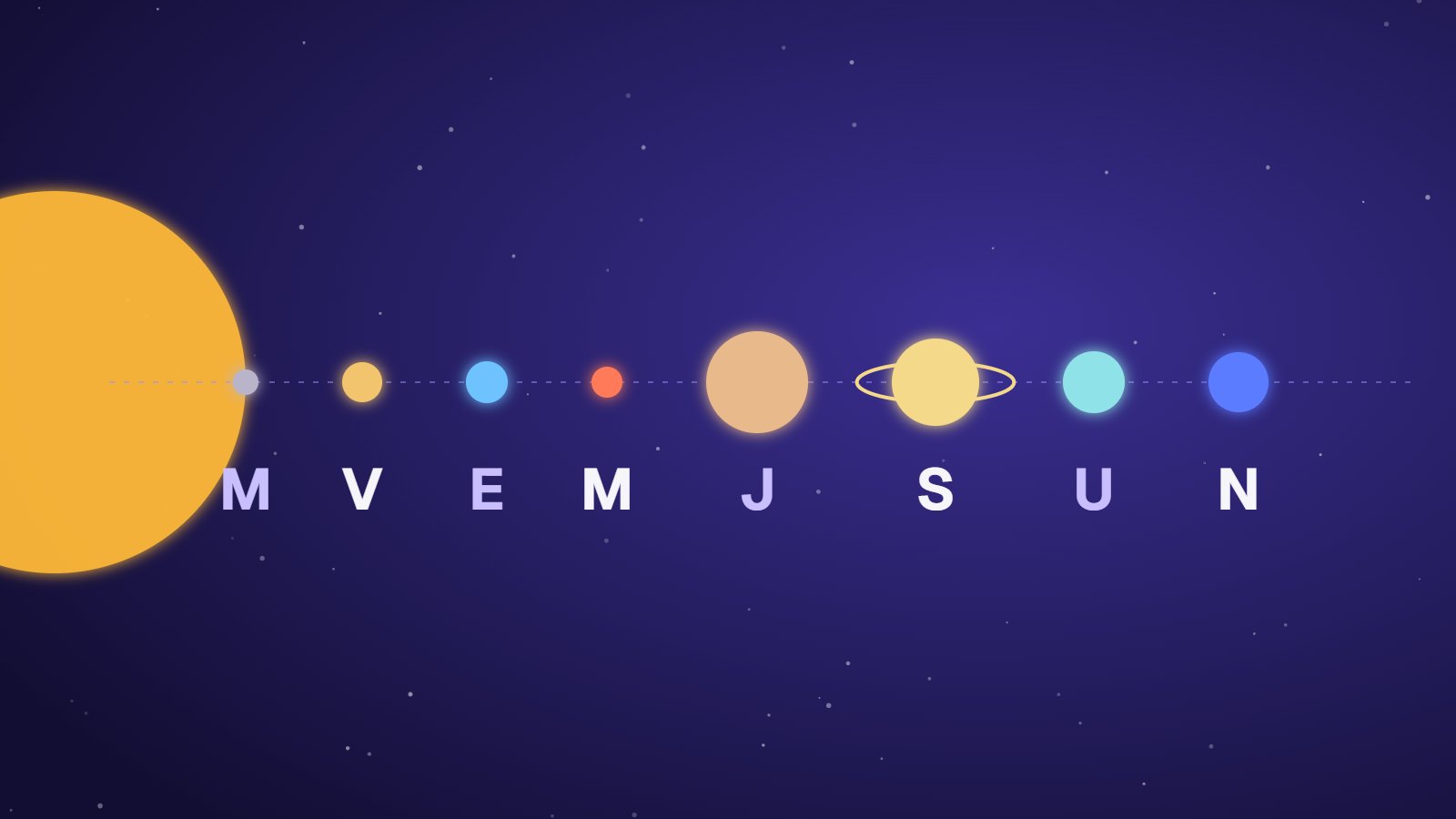
Each word starts with the same letter as the planet in that position. Planet sizes are relative, not to scale.
| # | Mnemonic | Subject | What it encodes |
|---|---|---|---|
| 1 | My Very Educated Mother Just Served Us Nachos | Astronomy | The eight planets in order from the Sun: Mercury, Venus, Earth, Mars, Jupiter, Saturn, Uranus, Neptune |
| 2 | ROY G. BIV | Physics | Colors of the visible spectrum: red, orange, yellow, green, blue, indigo, violet |
| 3 | King Philip Came Over For Good Soup | Biology | Levels of classification: kingdom, phylum, class, order, family, genus, species |
| 4 | PMAT | Biology | Stages of mitosis: prophase, metaphase, anaphase, telophase |
| 5 | PEMDAS (“Please Excuse My Dear Aunt Sally”) | Math | Order of operations: parentheses, exponents, multiplication and division, addition and subtraction |
| 6 | SOH-CAH-TOA | Math | Sine = opposite/hypotenuse, cosine = adjacent/hypotenuse, tangent = opposite/adjacent |
| 7 | FOIL | Math | Multiplying two binomials: first, outer, inner, last |
| 8 | King Henry Died By Drinking Chocolate Milk | Math and science | Metric prefixes in order: kilo, hecto, deka, base unit, deci, centi, milli |
| 9 | OIL RIG | Chemistry | Oxidation Is Loss, Reduction Is Gain (of electrons) |
| 10 | HOFBrINCl (“Hoff-brinkle”) | Chemistry | The seven elements that exist as diatomic molecules: hydrogen, oxygen, fluorine, bromine, iodine, nitrogen, chlorine |
| 11 | HOMES | Geography | The Great Lakes: Huron, Ontario, Michigan, Erie, Superior |
| 12 | Never Eat Shredded Wheat | Geography | Compass points clockwise from the top: north, east, south, west |
| 13 | “In fourteen hundred ninety-two, Columbus sailed the ocean blue” | History | The year of Columbus’s first transatlantic voyage |
| 14 | “Divorced, beheaded, died; divorced, beheaded, survived” | History | The fates of Henry VIII’s six wives, in order of marriage |
| 15 | “I before E, except after C” | Spelling | A spelling pattern for words like believe and receive (with many exceptions) |
What do these mnemonics leave out?
Many classic mnemonics simplify the facts, so it’s worth knowing where each one bends the truth. Using a mnemonic well means knowing its limits.
- The planets: older versions ended with “Nine Pizzas” for Pluto. In 2006 the International Astronomical Union reclassified Pluto as a dwarf planet, which is why the modern version ends with “Nachos.” Our planets song uses the eight-planet list.
- PEMDAS: multiplication and division have equal rank and are done left to right, as are addition and subtraction. Reading PEMDAS as six separate steps is one of the most common math errors. The order of operations song spells this out.
- King Philip: modern biology adds a level above kingdom, called domain.
- PMAT: interphase comes before mitosis and isn’t a stage of it, and cytokinesis usually overlaps with telophase. See the mitosis song for the full sequence.
- ROY G. BIV: the spectrum is continuous, and many scientists today don’t treat indigo as a separate color. The seven bands are a convention, not a physical boundary.
- Never Eat Shredded Wheat: you may see “Naughty Elephants Squirt Water” instead, which encodes the same order.
- Columbus: the rhyme fixes the date, but it says nothing about where he landed or about the people already living in the Americas.
- “I before E”: this rule has so many exceptions that it is unreliable on its own. Weird, their, seize, neighbor, weigh, height, science, species and ancient all break it. Longer versions add “or when sounded like A, as in neighbor and weigh,” which helps a little but still misses many words.
How do you make your own mnemonic?
To make your own mnemonic, list the items in the order you need them, take the first letter or a key sound from each, and build a short, vivid sentence, word or image around them. Personal, funny or strange mnemonics are usually easier to remember than bland ones.
- Write the list exactly. Check the correct terms and order in your textbook first. A mnemonic built on a mistake will faithfully help you remember the mistake.
- Choose the type. If the first letters spell something, use an acronym. If not, write an acrostic sentence. For a longer list, split it into chunks. For numbers or dates, try a rhyme (more ideas in how to memorize history dates).
- Make it vivid. Concrete, visual, slightly absurd sentences stick better than abstract ones. “Funny Clowns Bring Ice-cream” beats “Find Clear Bright Ideas” for the first four halogens.
- Keep it short. Seven or so items per mnemonic is a practical limit. Break longer lists into two.
- Test it from memory. Write the mnemonic and then the full list without looking. Repeat this on later days.
- Connect it to meaning. After you can recall the list, explain what each item means or why it’s in that position.
For example, to remember the first four noble gases (helium, neon, argon, krypton), you might write “Happy Ned Ate Krill.” Our guide on how to memorize the periodic table has more group mnemonics and a 7-day plan.
Do mnemonic devices actually work?
Mnemonic devices work for remembering specific facts, lists and sequences, but they do not build understanding, and their benefits can be narrow and short-lived. They are best used as one tool alongside practice testing and spaced review.
The most cited review of study strategies, by John Dunlosky and colleagues, evaluated ten techniques for how well their benefits generalize across learners, materials and tasks [5]. It rated the keyword mnemonic as low utility overall, because it is difficult to use for some kinds of material and appeared to help mainly with a limited range of content and over short retention intervals. The same review rated practice testing and distributed (spaced) practice as high utility.
That does not make mnemonics useless. It means they should be used for what they do well. A mnemonic can help you reliably recall that the order is kingdom, phylum, class; it cannot tell you why scientists group living things that way. PEMDAS gives you the order of operations, but not the reason that order exists or the skill to use it on a messy equation.
A sensible routine is to use a mnemonic or a song to get the list into memory, test yourself on it over several days, and spend most of your time on explanation and problem practice. Our post on spaced repetition and active recall explains how to schedule that review.
Are songs a type of mnemonic?
Yes, songs are a form of mnemonic: the melody and rhythm act as a structure that cues each word in order. They are one of the oldest memory aids, and they are especially useful for ordered lists, formulas and definitions.
BrainBeats is built on this idea, pairing short original songs with lyric-synced visuals so the words point to the concept they describe. Songs such as the Pythagorean theorem or the phases of the Moon carry the key terms; you still need to practice using them. Teachers who want to bring songs into lessons can find a step-by-step approach in our guide to teaching with music in the classroom.
Songs mentioned in this article
-
Eight Around the Sun The planets of the solar systemIndie Astronomy Ages 7–12
-
Left to Right The order of operationsJazz Math Ages 10–13
-
Split, Then Split Again MitosisHip-hop Biology Ages 13–16
-
Square the Legs The Pythagorean theoremFolk Math Ages 12–15
Frequently asked questions
What is an example of a mnemonic device?
A well-known example is “My Very Educated Mother Just Served Us Nachos,” where the first letter of each word stands for a planet in order from the Sun: Mercury, Venus, Earth, Mars, Jupiter, Saturn, Uranus and Neptune.
What are the main types of mnemonics?
The main types are acronyms, acrostics (first-letter sentences), rhymes and songs, chunking, the method of loci (memory palace) and the keyword method.
What is the mnemonic for the order of operations?
PEMDAS, often remembered as “Please Excuse My Dear Aunt Sally,” stands for parentheses, exponents, multiplication and division, addition and subtraction. Multiplication and division share a rank and are worked left to right, as are addition and subtraction.
Is “i before e except after c” true?
Only partly. Many common words break the rule, including weird, their, seize, neighbor, height, science and species, so it is best treated as a rough guide rather than a rule.
Do mnemonics help you learn?
Mnemonics help you recall specific facts and lists, but they do not create understanding on their own. Research reviews rate practice testing and spaced review as more broadly effective study techniques.
Sources
- Wallace, W. T. (1994). Memory for music: Effect of melody on recall of text. Journal of Experimental Psychology: Learning, Memory, and Cognition, 20(6), 1471–1485. doi.org/10.1037/0278-7393.20.6.1471
- Miller, G. A. (1956). The magical number seven, plus or minus two: Some limits on our capacity for processing information. Psychological Review, 63(2), 81–97. doi.org/10.1037/h0043158
- Maguire, E. A., Valentine, E. R., Wilding, J. M., & Kapur, N. (2003). Routes to remembering: The brains behind superior memory. Nature Neuroscience, 6(1), 90–95. doi.org/10.1038/nn988
- Dresler, M., Shirer, W. R., Konrad, B. N., Müller, N. C. J., Wagner, I. C., Fernández, G., Czisch, M., & Greicius, M. D. (2017). Mnemonic training reshapes brain networks to support superior memory. Neuron, 93(5), 1227–1235. doi.org/10.1016/j.neuron.2017.02.003
- Dunlosky, J., Rawson, K. A., Marsh, E. J., Nathan, M. J., & Willingham, D. T. (2013). Improving students’ learning with effective learning techniques: Promising directions from cognitive and educational psychology. Psychological Science in the Public Interest, 14(1), 4–58. doi.org/10.1177/1529100612453266
Keep reading
-

Ancient Greece and Rome: timeline, key facts and differences
Ancient Greece and Rome explained: a timeline from 776 BC to AD 1453, how the two differed, how Rome absorbed Greece, why the West fell and what they left us.
-

Best ways to memorize history dates: 8 methods that work
How to memorize history dates: learn a few anchor dates, attach events to a story, turn numbers into rhymes or pictures, then test yourself on a spaced schedule.