Math songs
Songs that make formulas, theorems and the order of operations stick. There are 14 math songs, each with synced lyrics, the key facts and a visualization.
-
01
Minus B The quadratic formulaIndie Math Ages 14–18
-
02
Square the Legs The Pythagorean theoremFolk Math Ages 12–15
-
03
Left to Right The order of operationsJazz Math Ages 10–13
-
04
All the Way Around Circles and piCountry Math Ages 11–14
-
05
Same Size Slices Adding fractionsPop Math Ages 9–12
-
06
Keep It Balanced Solving linear equationsHip-hop Math Ages 11–14
-
07
Interest on Interest Compound interestJazz Math Adults
-
08
Right Now DerivativesR&B Math College
-
09
Equal Groups Times tablesPop Math Ages 7–10
-
10
Under the Curve IntegralsJazz Math College
-
11
Long Shot Probability and oddsCountry Math Adults
-
12
Three Ratios SOH CAH TOAHip-hop Math Ages 14–18
-
13
What Power? LogarithmsJazz Math College
-
14
Out of a Hundred PercentagesPop Math Adults
What each song teaches
- Minus B The quadratic formula
- The quadratic formula solves any equation of the form ax² + bx + c = 0: x = (−b ± √(b² − 4ac)) / 2a. The discriminant, b² − 4ac, tells you how many real roots there are.
- Square the Legs The Pythagorean theorem
- The Pythagorean theorem says that in a right triangle, a² + b² = c², where c is the hypotenuse, the longest side, opposite the right angle. It lets you find a missing side: a triangle with legs of 3 and 4 has a hypotenuse of 5.
- Left to Right The order of operations
- The order of operations is the agreed set of rules for which part of a math expression to work out first: parentheses, exponents, multiplication and division, then addition and subtraction, often remembered as PEMDAS. Multiplication and division share a level and are done left to right, as are addition and subtraction, so 3 + 4 × 2 = 11, not 14.
- All the Way Around Circles and pi
- Pi (π) is the number you get when you divide any circle’s circumference by its diameter: about 3.14159, with digits that never end or repeat. The radius runs from the centre to the edge and the diameter is twice the radius, so the circumference is πd or 2πr and the area is πr².
- Same Size Slices Adding fractions
- To add fractions, the pieces must be the same size, so the denominators (bottom numbers) must match. If they don’t, change one or both into equivalent fractions with a common denominator, add the numerators (top numbers), keep the denominator, then simplify.
- Keep It Balanced Solving linear equations
- Solving a linear equation means finding the value of the unknown, like x, that makes both sides equal. Think of the equation as a balance: do the same inverse operation to both sides to undo what has been done to x, until x is on its own, then check by substituting back in. For example, 2x + 3 = 11 gives 2x = 8, so x = 4.
- Interest on Interest Compound interest
- Compound interest is interest calculated on both your original money (the principal) and the interest it has already earned, so the balance grows faster each period. The formula A = P(1 + r/n)^(nt) gives the final amount, where P is the principal, r is the yearly interest rate as a decimal, n is how many times a year interest is compounded and t is the number of years. For example, $1,000 at 10% a year for 3 years grows to $1,300 with simple interest but to $1,331 compounded annually. The rule of 72 estimates doubling time: divide 72 by the yearly rate, so at 8% money roughly doubles in about 9 years. The same effect works against you on debt, such as an unpaid credit card balance.
- Right Now Derivatives
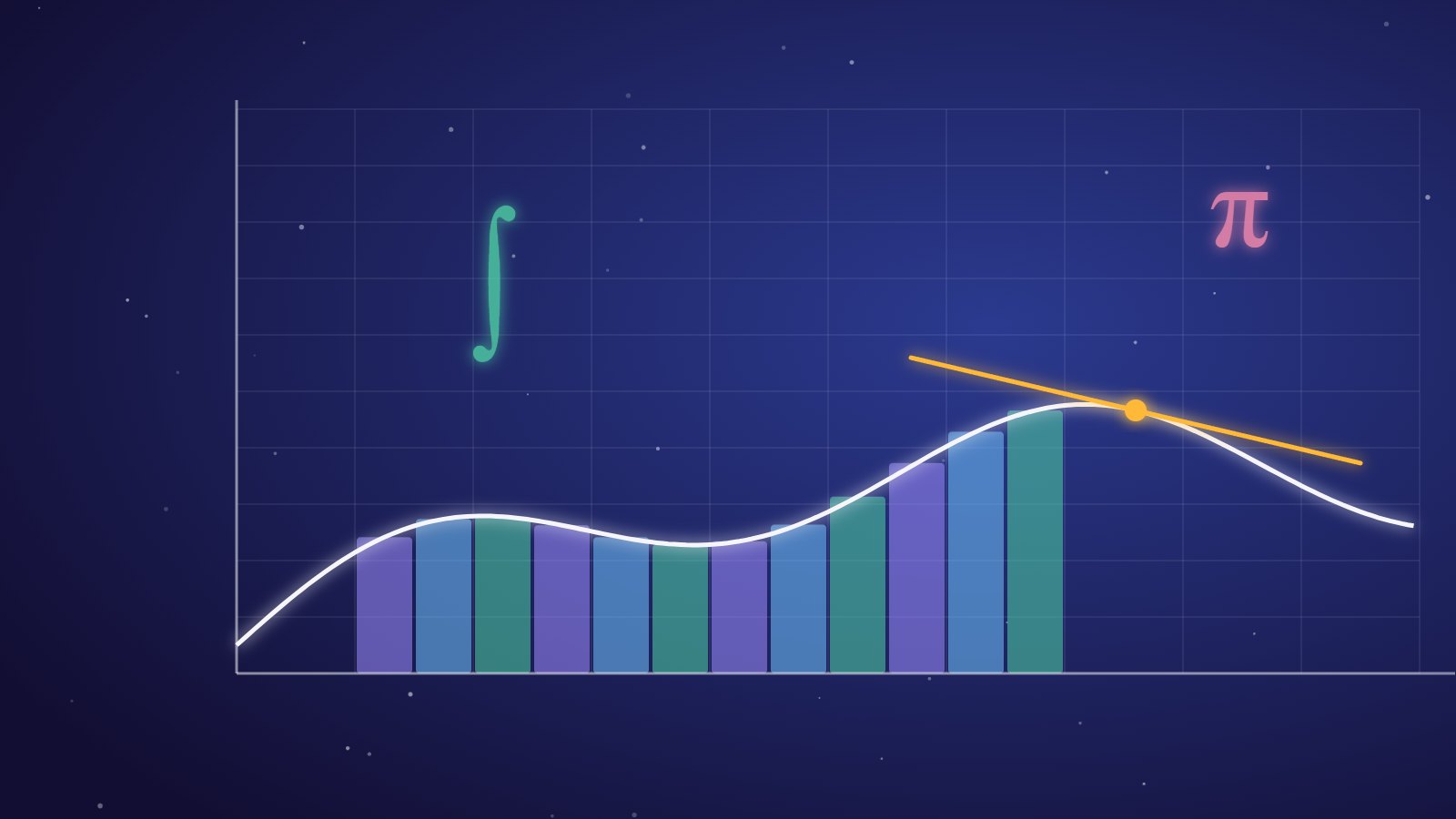
- A derivative is the instantaneous rate of change of a function: the slope of the tangent line to its graph at a single point. It is defined as a limit: take the slope of the secant line between x and x + h, then let the gap h shrink toward zero. The power rule says the derivative of xⁿ is nxⁿ⁻¹, so x² becomes 2x and x³ becomes 3x², while the derivative of any constant is zero. Isaac Newton and Gottfried Wilhelm Leibniz developed calculus independently in the late 1600s, and Leibniz’s dy/dx notation is still used today.
- Equal Groups Times tables
- Times tables are lists of multiplication facts, and multiplication is a quick way of adding equal groups: 3 × 4 means 3 groups of 4, which is 4 + 4 + 4 = 12. You can show multiplication as an array, with objects in equal rows and columns. The order doesn’t change the answer, so 3 × 4 and 4 × 3 both make 12; this is called the commutative property. Handy tricks help you remember: times 2 means doubling, times 10 puts a zero on the end of a whole number, times 5 answers always end in 0 or 5, and in the 9 times table the digits add up to 9.
- Under the Curve Integrals
- An integral adds up a quantity over an interval, and the definite integral of a function from a to b gives the area between its curve and the x-axis over that interval, with area below the axis counted as negative. It is defined as the limit of Riemann sums: split the interval into thin rectangles, add up their areas, and let the rectangles get thinner and more numerous. Integration reverses differentiation: an antiderivative of f is a function F whose derivative is f, and the power rule for integrals says the integral of xⁿ is xⁿ⁺¹/(n + 1) + C for any n ≠ −1. The Fundamental Theorem of Calculus says the definite integral of f from a to b equals F(b) − F(a), so the integral of x² from 0 to 3 is 3³/3 − 0 = 9.
- Long Shot Probability and odds
- Probability is a number from 0 to 1 that measures how likely something is to happen: 0 means impossible, 1 means certain, and when every outcome is equally likely it equals the number of favorable outcomes divided by the number of possible outcomes. Odds compare chances for against chances against, so odds of 1 to 3 in favor mean one win for every three losses, a probability of 1/4. For independent events you multiply the probabilities, so two fair coins both landing heads has a probability of 1/2 × 1/2 = 1/4, and past results don’t change future ones: believing a result is “due” is the gambler’s fallacy. Expected value, the average result per play over the long run, shows why casino games and lotteries lose money on average; the odds of winning the Powerball jackpot with one ticket are 1 in 292,201,338.
- Three Ratios SOH CAH TOA
- SOH CAH TOA is a memory aid for the three basic trigonometric ratios in a right-angled triangle: sine = opposite ÷ hypotenuse, cosine = adjacent ÷ hypotenuse and tangent = opposite ÷ adjacent. The hypotenuse is the longest side, opposite the right angle; the opposite side is across from the angle you are using, and the adjacent side is next to that angle but is not the hypotenuse. To find a missing side, pick the ratio that links the side you know to the side you want: if the hypotenuse is 10 and the angle is 30°, the opposite side is 10 × sin 30° = 5. To find a missing angle, use an inverse function: if the opposite and adjacent sides are both 3, tan θ = 1 and θ = tan⁻¹(1) = 45°. Useful exact values include sin 30° = 1/2, cos 60° = 1/2 and tan 45° = 1.
- What Power? Logarithms
- A logarithm answers the question “what power?”: the logarithm base b of x is the exponent you must raise b to in order to get x, so log base 2 of 8 is 3 because 2³ = 8. Logarithms are the inverse of exponential functions, so each undoes the other. Three rules make them useful: the log of a product is the sum of the logs, the log of a quotient is the difference, and the log of a power is the exponent times the log. The natural logarithm, ln, uses base e (about 2.718), and logarithmic scales such as pH, decibels and earthquake magnitude turn huge ranges into small numbers.
- Out of a Hundred Percentages
- A percentage is an amount expressed as a number out of 100: percent means “per hundred”, so 25% is 25/100, or 0.25. To find a percentage of an amount, turn the percentage into a decimal and multiply, so 15% of 80 is 0.15 × 80 = 12. Percent change is the change divided by the original value, times 100, so going from 50 to 60 is a 20% increase. To reverse a percentage change, divide rather than add or subtract: something that costs 80 after 20% off was originally 80 ÷ 0.8 = 100, not 96. Successive percentage changes multiply rather than add, and a rise from 2% to 3% is one percentage point but a 50% increase.
Song guides
Math song questions
Still wondering about something? Ask us and we’ll reply within two working days.
What math topics do the songs cover?
The math songs cover the quadratic formula, the Pythagorean theorem, the order of operations, circles and pi, adding fractions, solving linear equations, compound interest, derivatives, times tables, integrals, probability and odds, SOH CAH TOA, logarithms and percentages.
What age are the math songs for?
They are written for ages 14–18, ages 12–15, ages 10–13, ages 11–14, ages 9–12, adults, college, ages 7–10, and adults refreshing the subject use them too. Each song page lists its level.