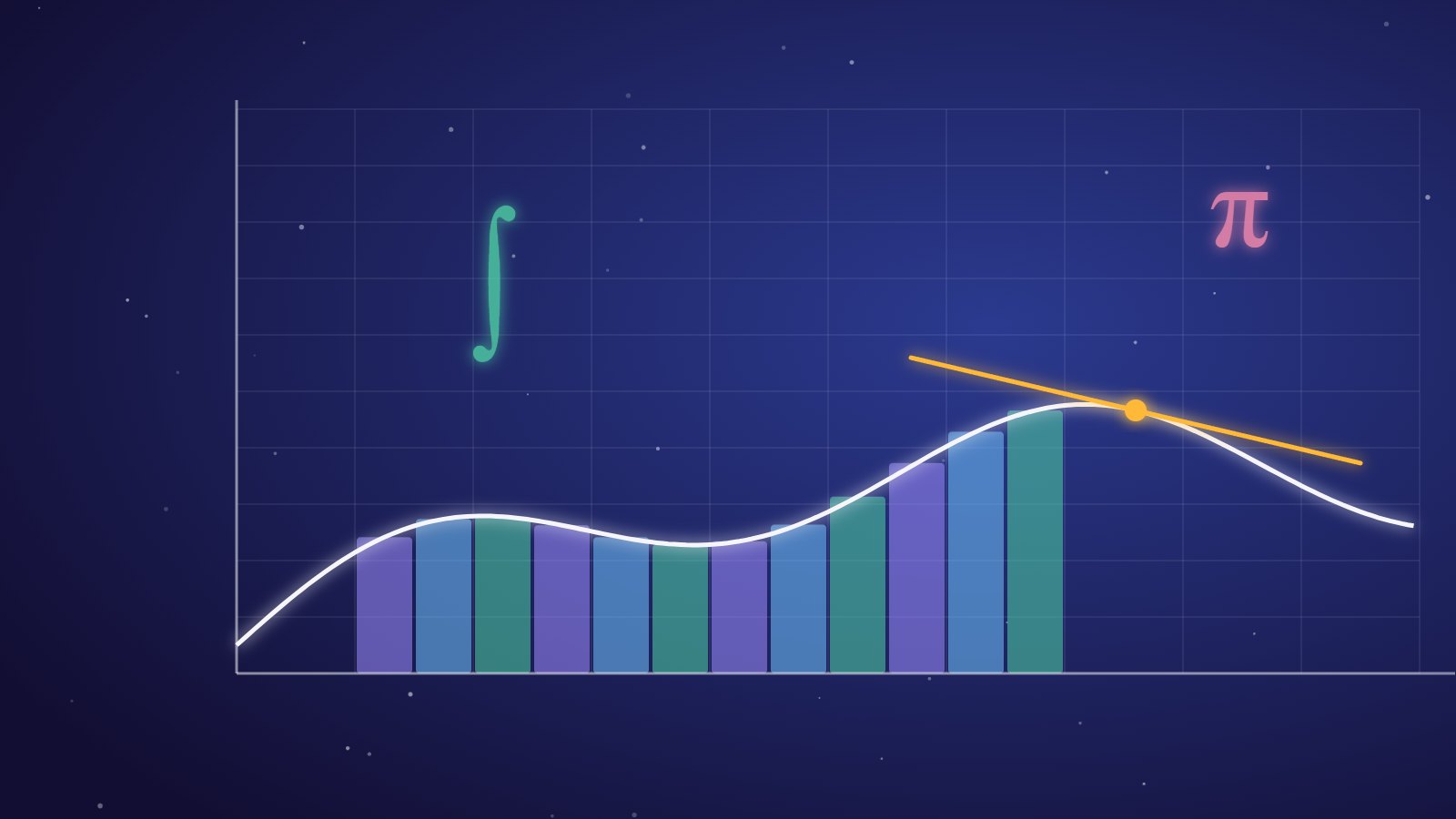
Right Now A song about derivatives
Sing it back
Can you finish the lyrics?
Eight quick questions on “Right Now”. No music, just your memory. Then share your score and challenge a friend.
Derivatives in one paragraph
A derivative is the instantaneous rate of change of a function: the slope of the tangent line to its graph at a single point. It is defined as a limit: take the slope of the secant line between x and x + h, then let the gap h shrink toward zero. The power rule says the derivative of xⁿ is nxⁿ⁻¹, so x² becomes 2x and x³ becomes 3x², while the derivative of any constant is zero. Isaac Newton and Gottfried Wilhelm Leibniz developed calculus independently in the late 1600s, and Leibniz’s dy/dx notation is still used today.
Key facts from the song
- A derivative gives the instantaneous rate of change of a function, which is the slope of the tangent line at a point.
- It is defined as the limit of secant-line slopes, (f(x + h) − f(x)) / h, as h approaches zero.
- The power rule: the derivative of xⁿ is nxⁿ⁻¹, so the derivative of x² is 2x.
- The derivative of a constant is zero, because a horizontal line has zero slope.
- Newton and Leibniz developed calculus independently in the late 1600s; dy/dx is Leibniz’s notation.
Where it fits in your course
- US level
- College (undergraduate)
Lyrics
Verse 1
Take two points upon the curve and draw a secant line between
Rise over run gives the average rate of change across the scene
Slide the second point in closer till the gap h nearly disappears
The limit of those slopes is the derivative, the tangent’s slope appears
Chorus
Derivative, derivative, the rate of change right now
The slope of the tangent line, let me show you how
Bring the power down in front, then take one off the power
So x squared becomes two x, it’s the power rule’s finest hour
Verse 2
Same rule for x cubed, it turns to three x squared every time
A constant’s derivative is zero, ’cause a flat line doesn’t climb
In the late sixteen hundreds, Newton and Leibniz each found the key
Leibniz wrote it dy over dx, the notation we still use, you see
Chorus
Derivative, derivative, the rate of change right now
The slope of the tangent line, let me show you how
Bring the power down in front, then take one off the power
So x squared becomes two x, it’s the power rule’s finest hour
Outro
Derivative, the rate of change, the tangent’s slope in sight
From the limit to the power rule, now you’ve got it right
Derivatives flashcards
Say the answer out loud, then tap the card to check it. Or test yourself quick-fire.
1What does a derivative measure?
The instantaneous rate of change of a function: the slope of the tangent line at a point.
2What is the limit definition of the derivative?
The limit of (f(x + h) − f(x)) / h as h approaches zero: secant slopes becoming the tangent slope.
3What does the power rule give for the derivative of x²?
2x. In general the derivative of xⁿ is nxⁿ⁻¹.
4What is the derivative of a constant, and why?
Zero, because a constant never changes and its graph is a flat line with zero slope.
Questions about derivatives
Still wondering about something? Ask us and we’ll reply within two working days.
What is a derivative in simple terms?
A derivative tells you how fast something is changing at one exact moment. On a graph, it is the slope of the tangent line that just touches the curve at that point.
What is the limit definition of a derivative?
The derivative of f at x is the limit, as h approaches zero, of (f(x + h) − f(x)) / h. That fraction is the slope of a secant line between two points; as h shrinks, it becomes the slope of the tangent.
What is the power rule in calculus?
To differentiate x raised to a power n, bring the power down in front and subtract one from the power: the derivative of xⁿ is nxⁿ⁻¹. For example, the derivative of x² is 2x and the derivative of x³ is 3x².
Why is the derivative of a constant zero?
A constant never changes, so its rate of change is zero. Its graph is a horizontal line, and a horizontal line has a slope of zero.