Math songs from times tables to calculus: 14 songs by level
Math songs for every level: 14 short songs from times tables and fractions to the quadratic formula, derivatives and compound interest, and what each teaches.
Key takeaways
- BrainBeats has 14 math songs, running from times tables in elementary school to derivatives and integrals in college, plus three everyday-math songs for adults.
- Math songs are most useful for things you must reproduce exactly: a formula, a rule like PEMDAS, or a memory aid like SOH CAH TOA.
- Knowing a formula by heart is not the same as knowing when to use it, so every song should be followed by worked problems.
- Practice testing and spaced practice are among the best-supported study techniques, and they matter more than how many times you replay a song.
- Each level builds on the one before: fractions and order of operations lead to equations, which lead to the quadratic formula and on to calculus.
Math songs help most with the things you have to remember exactly: a formula, a rule or a set of facts like the times tables. BrainBeats has 14 math songs, ordered here by level from times tables in elementary school to integrals in college, plus three songs on the everyday math adults use. Each entry says what the song teaches, so you can find the one that matches what you’re working on.
Every song has a page with lyrics, key facts, flashcards and a quiz. Levels follow US schooling: elementary (grades 3–5), middle school, high school, college and adult learners. You can browse them all in our math category, or see how they map to standards in our Common Core math guide.
| Level | Song | What it teaches |
|---|---|---|
| Elementary | Times tables | Multiplication as equal groups, plus times-table tricks |
| Elementary | Adding fractions | Common denominators and simplifying |
| Elementary, middle | Order of operations | PEMDAS and working left to right |
| Middle | Circles and pi | Radius, diameter, circumference and area |
| Middle | Solving linear equations | Balancing both sides with inverse operations |
| Middle | The Pythagorean theorem | a² + b² = c² for right triangles |
| High school | The quadratic formula | Solving ax² + bx + c = 0 and the discriminant |
| High school | SOH CAH TOA | Sine, cosine and tangent in right triangles |
| College | Logarithms | “What power?”, log rules and the natural log |
| College | Derivatives | Instantaneous rate of change and the power rule |
| College | Integrals | Area under a curve and the Fundamental Theorem |
| Adult | Percentages | Percent of, percent change and reversing a discount |
| Adult | Compound interest | Interest on interest and the rule of 72 |
| Adult | Probability and odds | Probability, odds, the gambler’s fallacy and expected value |
What math songs are there for elementary school?
Three songs cover the number skills that most later math depends on: multiplication facts, fractions and the order of operations.
Times tables
Equal Groups teaches multiplication as adding equal groups, so 3 × 4 is 4 + 4 + 4, and shows it as an array of rows and columns. It covers the commutative property (3 × 4 = 4 × 3) and handy tricks: times 2 means double, times 10 puts a zero on the end of a whole number, times 5 answers end in 0 or 5, and the digits in the 9 times table add up to 9.
Adding fractions
Same Size Slices explains why you can only add fractions when the pieces are the same size: the denominators have to match. It shows how to make equivalent fractions by multiplying top and bottom by the same number, add the numerators, keep the denominator, and then simplify. The key rule it repeats is never to add the bottoms.
Order of operations
Left to Right teaches PEMDAS: parentheses, exponents, multiplication and division, then addition and subtraction. It focuses on the part students most often get wrong, that multiplication and division share a level and are worked left to right, as are addition and subtraction. Its example: 3 + 4 × 2 = 11, not 14. It suits upper elementary and middle school.
What math songs are there for middle school?
Three middle school songs move from arithmetic into geometry and algebra.
Circles and pi
All the Way Around defines pi as any circle’s circumference divided by its diameter, about 3.14159, with digits that never end or repeat. It separates radius from diameter and gives both key formulas: circumference is πd or 2πr, and area is πr².
Solving linear equations
Keep It Balanced treats an equation as a balance: whatever you do to one side, do to the other. It uses inverse operations to undo what has been done to x, works through 2x + 3 = 11 to get x = 4, and finishes with checking the answer by substituting it back in.
The Pythagorean theorem
Square the Legs teaches a² + b² = c² and stresses that it works only for right triangles, with c as the hypotenuse opposite the right angle. It uses the 3-4-5 triangle as its example and shows how to find a missing leg by subtracting instead of adding.
What math songs are there for high school?
Two high school songs cover formulas students are expected to recall quickly in algebra and trigonometry.
The quadratic formula
Minus B sets the quadratic formula, x = (−b ± √(b² − 4ac)) / 2a, to music. It also covers the discriminant, b² − 4ac, which tells you whether there are two real roots, one repeated root or none, and notes that the vertex of the parabola sits at x = −b / 2a.
SOH CAH TOA
Three Ratios uses the memory aid SOH CAH TOA for sine, cosine and tangent in a right triangle, and explains how to tell the opposite, adjacent and hypotenuse sides apart. It shows how to find a missing side (with a hypotenuse of 10 and an angle of 30°, the opposite side is 5) and a missing angle with inverse functions, and lists exact values such as sin 30° = 1/2 and tan 45° = 1.
What math songs are there for college?
Three college-level songs cover logarithms and the two central ideas of calculus. They also work for strong high school students in precalculus or AP Calculus.
Logarithms
What Power? frames a logarithm as the answer to “what power?”: log base 2 of 8 is 3 because 2³ = 8. It covers logarithms as the inverse of exponential functions, the product, quotient and power rules, the natural log with base e, and why log scales such as pH, decibels and earthquake magnitude turn huge ranges into small numbers.
Derivatives
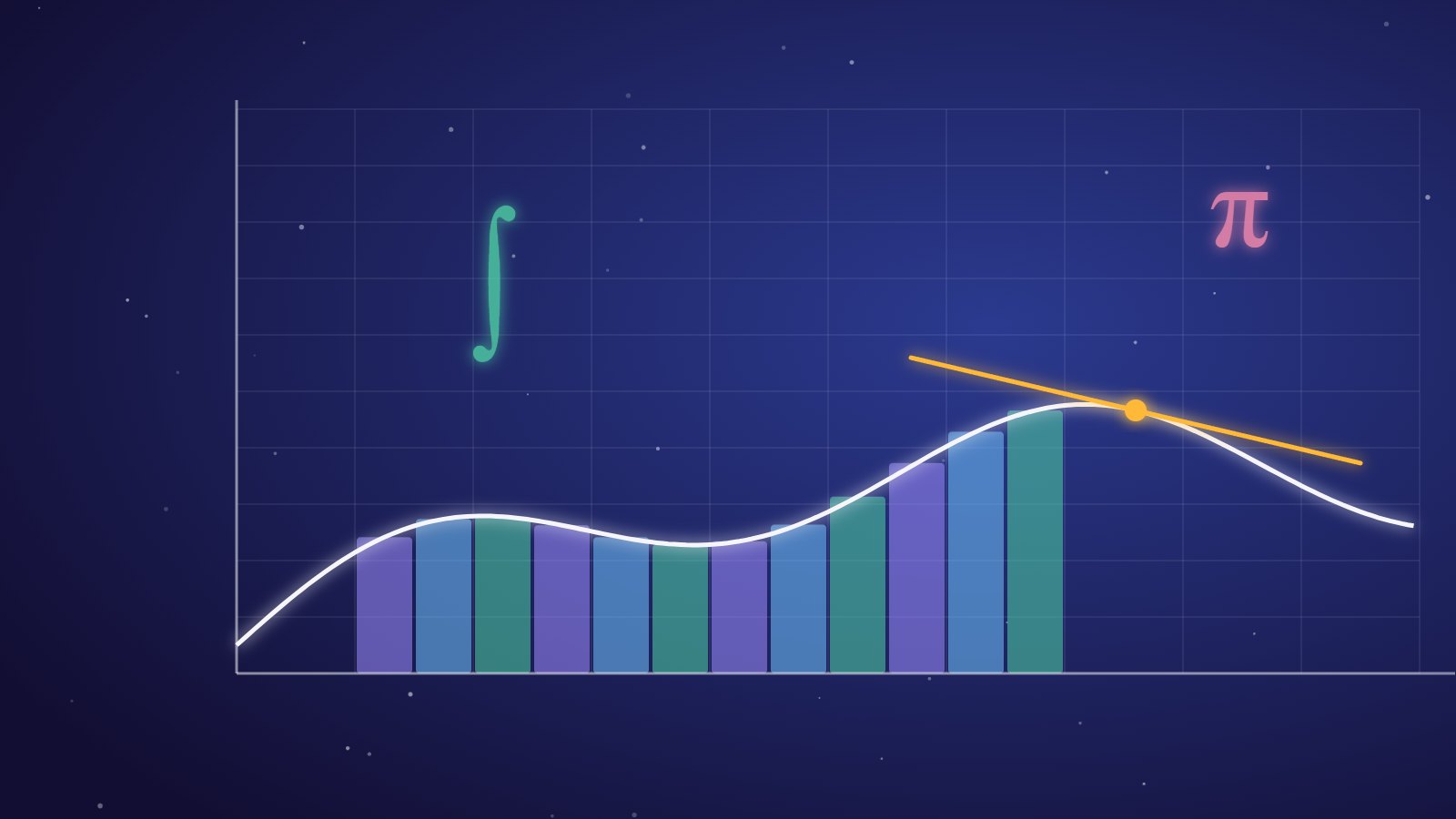
Right Now explains the derivative as the instantaneous rate of change, the slope of the tangent line at a point, defined as the limit of secant slopes as the gap shrinks to zero. It teaches the power rule (x² becomes 2x), why the derivative of a constant is zero, and that Newton and Leibniz developed calculus independently in the late 1600s.
Integrals
Under the Curve covers the definite integral as signed area under a curve, defined as the limit of Riemann sums of thinner and thinner rectangles. It teaches antiderivatives, the power rule for integrals and the reason for the + C, and the Fundamental Theorem of Calculus, with the worked example that the integral of x² from 0 to 3 is 9.
What math songs are there for adults?
Three songs cover the math adults use for money, shopping and risk. They suit anyone who wants a refresher, and older high school students too.
Percentages
Out of a Hundred explains that percent means “per hundred” and shows how to find a percentage of an amount and work out percent change. It covers two traps: undoing a discount by dividing (a price of 80 after 20% off was 100, not 96), and the difference between a percentage point and a percent change.
Compound interest
Interest on Interest compares simple and compound interest, using $1,000 at 10% for three years ($1,300 simple versus $1,331 compounded annually). It teaches the formula A = P(1 + r/n)^(nt), the rule of 72 for estimating how long money takes to double, and that compounding works against you on debt such as an unpaid credit card balance.
Probability and odds
Long Shot covers probability from 0 (impossible) to 1 (certain), the difference between probability and odds, and multiplying probabilities for independent events. It explains the gambler’s fallacy and expected value, which shows why casino games and lotteries lose money on average.
How do you use math songs to actually get better at math?
Use the song to memorize the formula or rule, then practice problems until you can choose and apply it without the song. A song can make the quadratic formula stick, but it can’t tell you when a problem calls for it.
The research on songs suggests why they suit formulas. In Wanda Wallace’s experiments, a simple melody repeated across verses helped people recall the exact wording of a text [1], and exact wording is what a formula demands. But another study found no recall advantage for lyrics learned by singing, and its authors suggested that learning new words and an unfamiliar tune together is effectively a dual task [2], so expect a song to help most once the tune is familiar. Our article does music help you learn? has the fuller picture.
A routine that works for most levels:
- Learn it. Listen to the song two or three times with the lyrics on screen.
- Write it from memory. Close the lyrics and write the formula or rule. Check it, fix it, repeat.
- Use it. Work three or four problems right away, pointing to where each part of the lyric appears in your working.
- Mix it up. Later, practice problems that need different methods in one set, so you have to decide which one fits. A large review of study techniques rated this kind of interleaved practice as moderately useful, and practice testing and spaced practice as the most useful of all [3].
- Come back. Revisit the song and a few problems after a few days, then a week later. Our guide to spaced repetition and active recall explains how to schedule it.
Memory aids like PEMDAS and SOH CAH TOA are mnemonics in their own right; see mnemonic devices with examples for more. Teachers can find a classroom version of this routine in teaching with music in the classroom.
Songs mentioned in this article
-
Equal Groups Times tablesPop Math Ages 7–10
-
Same Size Slices Adding fractionsPop Math Ages 9–12
-
Keep It Balanced Solving linear equationsHip-hop Math Ages 11–14
-
Three Ratios SOH CAH TOAHip-hop Math Ages 14–18
-
Right Now DerivativesR&B Math College
-
Interest on Interest Compound interestJazz Math Adults
Frequently asked questions
Do math songs help you learn math?
Math songs can help you remember formulas, rules and facts word for word, which is useful, but they don’t teach you when or how to use them. Follow every song with worked problems and self-testing.
What is the best song for learning the times tables?
Look for a song that explains multiplication as equal groups and gives tricks for the harder tables, then practice the facts out of order. The BrainBeats times tables song covers arrays, the commutative property and tricks for the 2, 5, 9 and 10 times tables.
Is there a song for the quadratic formula?
Yes. The BrainBeats quadratic formula song covers x = (−b ± √(b² − 4ac)) / 2a and what the discriminant tells you about the number of real roots.
Are there songs for calculus?
BrainBeats has college-level songs on derivatives and integrals, plus one on logarithms. They cover definitions, the power rules and the Fundamental Theorem of Calculus, and also suit students in AP Calculus.
Can adults use math songs?
Yes. Three songs, on percentages, compound interest and probability and odds, focus on the math adults use for shopping, saving, borrowing and judging risk.
Sources
- Wallace, W. T. (1994). Memory for music: Effect of melody on recall of text. Journal of Experimental Psychology: Learning, Memory, and Cognition, 20(6), 1471–1485. doi.org/10.1037/0278-7393.20.6.1471
- Racette, A., & Peretz, I. (2007). Learning lyrics: To sing or not to sing? Memory & Cognition, 35(2), 242–253. doi.org/10.3758/BF03193445
- Dunlosky, J., Rawson, K. A., Marsh, E. J., Nathan, M. J., & Willingham, D. T. (2013). Improving students’ learning with effective learning techniques: Promising directions from cognitive and educational psychology. Psychological Science in the Public Interest, 14(1), 4–58. doi.org/10.1177/1529100612453266
Keep reading
-
Ancient Greece and Rome: timeline, key facts and differences
Ancient Greece and Rome explained: a timeline from 776 BC to AD 1453, how the two differed, how Rome absorbed Greece, why the West fell and what they left us.
-
Best ways to memorize history dates: 8 methods that work
How to memorize history dates: learn a few anchor dates, attach events to a story, turn numbers into rhymes or pictures, then test yourself on a spaced schedule.