History songs for students: 16 songs from Egypt to the Cold War
History songs for students in time order: 16 short songs from ancient Egypt to the World Wars and civil rights, grouped by era with the level each suits.
Key takeaways
- BrainBeats has 16 history songs covering about 5,000 years, from the unification of Egypt around 3100 BC to the end of the Cold War in 1991.
- Seven songs start at elementary level, three at middle school, three at high school, two at college and one is written for adult learners.
- History songs are best at fixing dates, names and sequences of events, which gives students a framework to hang explanations on.
- A song can’t argue about causes or weigh evidence, so pair it with a “why” question or a source discussion.
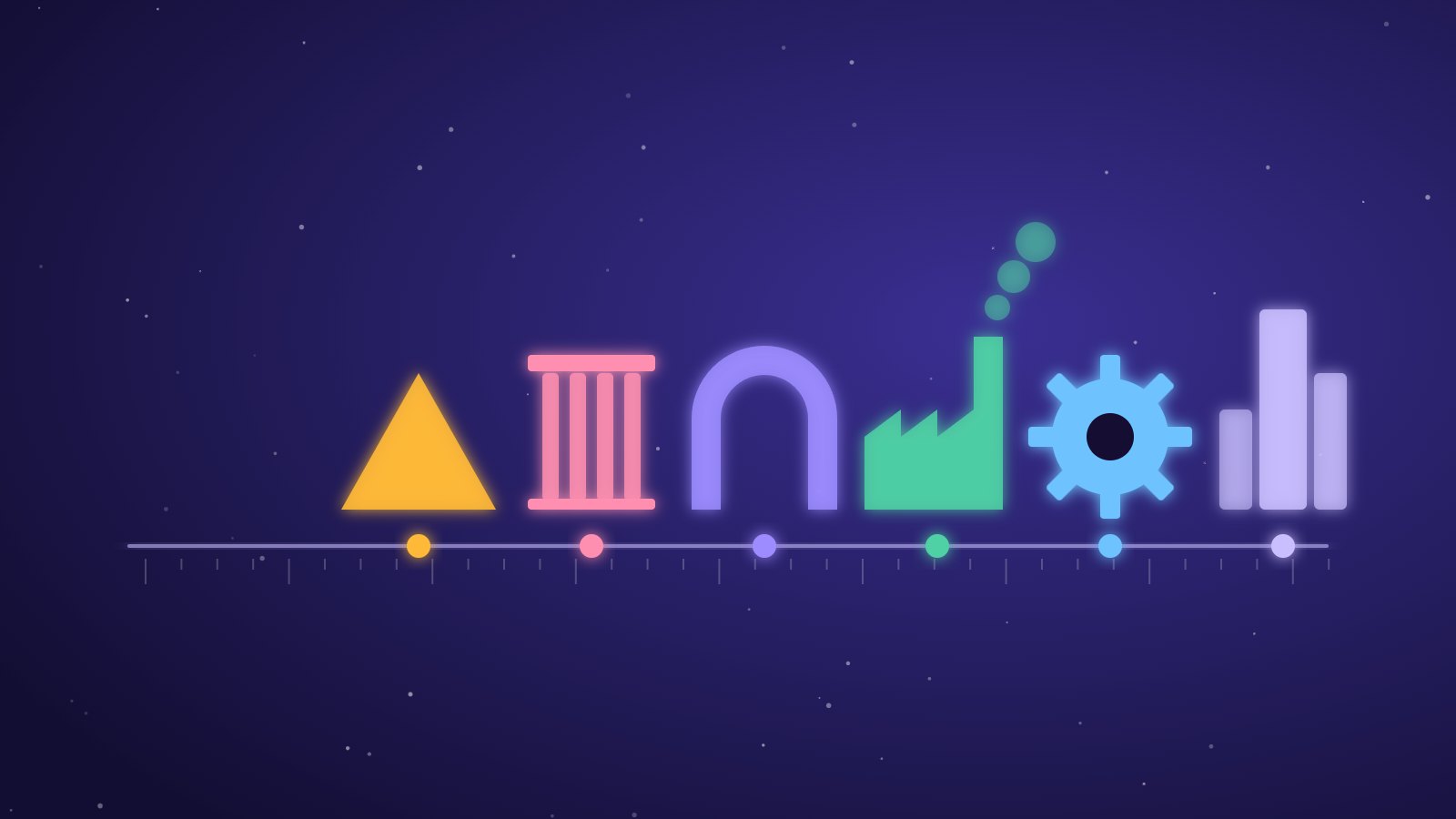
- Listening to the songs in time order builds a mental timeline and shows how periods overlap and connect.
History songs work best for the parts of history students have to get exactly right: dates, names and the order things happened. BrainBeats has 16 history songs, from ancient Egypt to the Cold War. Below they are listed in time order, grouped by era, with the school level each suits, so you can use them to build a timeline as well as to review a single topic.
Each song has a page with the full lyrics, key facts, flashcards and a quiz. Levels follow US schooling: elementary (grades 3–5), middle school, high school, college and adult learners. You can also browse every song in our history category.
| Song | Period covered | Best suited to |
|---|---|---|
| Ancient Egypt | c. 3100 BC – 30 BC | Elementary, middle school |
| Egyptian hieroglyphics | Ancient Egypt to AD 394; deciphered 1822 | Elementary, middle school |
| Mummification | Ancient Egypt | Elementary, middle school |
| Ancient Greece | From c. 800 BC | Elementary |
| Ancient Rome | 753 BC – AD 476 | Elementary, middle school |
| The Vikings | c. AD 793 – 1066 | Elementary |
| Magna Carta | 1215 | Middle school |
| The Renaissance | c. 14th – 17th century | College |
| The Protestant Reformation | 1517 – 1555 | College |
| The Industrial Revolution | From c. 1760 | Middle, high school |
| The American Revolution | 1773 – 1783 | Elementary, middle school |
| The French Revolution | 1789 – 1799 | High school |
| Causes of World War One | 1914 – 1918 | Middle, high school |
| World War II | 1939 – 1945 | High school |
| The Cold War | Late 1940s – 1991 | Adult learners |
| The civil rights movement | Mainly 1950s – 1960s | High school |
Which songs cover the ancient world?
Five songs cover the ancient civilizations most often taught in elementary and middle school: three on Egypt, one on Greece and one on Rome.
Ancient Egypt (c. 3100 BC – 30 BC)
Gift of the Nile explains why Egypt grew up along the River Nile: its yearly flood left rich black soil for farming. It covers King Narmer uniting Upper and Lower Egypt around 3100 BC, the pyramids as royal tombs, the boy king Tutankhamun, and Cleopatra VII, the last pharaoh, after whose death in 30 BC Egypt became part of the Roman Empire. Suits elementary and middle school.
Egyptian hieroglyphics (to AD 394, deciphered 1822)
Sacred Carvings teaches that “hieroglyph” is a Greek word meaning sacred carving, that the script had more than 700 signs for sounds, words and meanings, and that royal names were written inside a cartouche. It ends with the Rosetta Stone, found in 1799, which carries one decree in three scripts and let Jean-François Champollion decipher hieroglyphs in 1822. Suits elementary and middle school.
Mummification
Seventy Days walks through the roughly 70-day process step by step: removing the brain, storing the lungs, liver, stomach and intestines in four canopic jars while leaving the heart inside, drying the body in natron salt for 40 days, then wrapping it in linen with amulets. It is a natural sequence song. Suits elementary and middle school.
Ancient Greece (from c. 800 BC)
Olive Crowns introduces Greece as a land of independent city-states, with Athens developing democracy (though only adult male citizens could vote) and Sparta training its boys as soldiers. It covers the first recorded Olympic Games at Olympia in 776 BC, the gods of Mount Olympus, and the chain of teachers from Socrates to Plato to Aristotle. Suits elementary school.
Ancient Rome (753 BC – AD 476)
All Roads Lead to Rome covers Rome’s rise from a small city, traditionally founded in 753 BC, through the Republic of elected consuls and the Senate, to Augustus becoming the first emperor in 27 BC. It ends with the empire splitting and the Western Empire falling in AD 476, while the Eastern Empire lasted until 1453. Suits elementary and middle school.
For the history behind these two songs, with a side-by-side timeline and how Greece and Rome differed, see our guide to ancient Greece and Rome.
Which songs cover the Middle Ages?
Two songs cover the medieval period, one on the Viking Age and one on a single document that still shapes ideas about law and power.
The Vikings (c. AD 793 – 1066)
Raid and Trade dates the Viking Age from the raid on Lindisfarne in 793 to 1066 and shows that Vikings from Norway, Sweden and Denmark were traders, farmers and settlers as well as raiders. It covers the Danelaw and Jorvik (York), the settlement of Iceland and Greenland, Leif Erikson reaching North America around AD 1000, and the myth of horned helmets. Suits elementary school.
Magna Carta (1215)
The Law Is Over All explains that King John agreed to Magna Carta at Runnymede in June 1215 to make peace with his rebellious barons. It covers the clause that no free man could be imprisoned without lawful judgment, the Pope annulling the charter within months, and its reissue after John died, which helped it become a symbol of rulers being bound by law. Suits middle school.
Which songs cover the Renaissance and Reformation?
Two songs, both pitched at college level, cover the cultural and religious changes in Europe between the 14th and 17th centuries. Advanced high school students studying European history may find them useful too.
The Renaissance (c. 14th – 17th century)
Born Anew explains that Renaissance means “rebirth” and that the movement revived classical Greek and Roman learning, beginning in Italian city-states such as Florence with patrons like the Medici. It covers humanism, linear perspective, Michelangelo’s Sistine Chapel ceiling, and Gutenberg’s printing press carrying ideas north. It also notes that historians still debate how sharp a break it was from the Middle Ages. Suits college.
The Protestant Reformation (1517 – 1555)
Faith Alone starts with Martin Luther’s Ninety-Five Theses in 1517 and his teachings of faith alone and scripture alone, spread quickly by the printing press. It covers the Diet of Worms in 1521, John Calvin in Geneva, Henry VIII’s Act of Supremacy in 1534, the Council of Trent and the Peace of Augsburg in 1555. Suits college.
Which songs cover the age of revolutions?
Three songs cover the political and economic revolutions of the late 18th century. They overlap in time, which is worth pointing out to students: the Industrial Revolution was already under way in Britain while the American and French revolutions were being fought.
The Industrial Revolution (from c. 1760)
Full Steam Ahead describes the shift from making goods by hand to making them with machines in factories, starting in Britain around 1760. It covers James Watt’s more efficient steam engine, textile mills, iron-making, railways and the move to cities, as well as child labor and the Factory Act of 1833. Suits middle and high school.
The American Revolution (1773 – 1783)
Without Representation explains the colonists’ objection to taxes passed by a Parliament where they had no representatives, then moves through the Boston Tea Party in 1773, the first fighting at Lexington and Concord in 1775, and the Declaration of Independence on July 4, 1776. It ends with victory at Yorktown in 1781, with French help, and the Treaty of Paris in 1783. Suits elementary and middle school.
The French Revolution (1789 – 1799)
1789 puts the key dates in order: the storming of the Bastille on 14 July 1789, the Declaration of the Rights of Man and of the Citizen that August, the end of the monarchy in 1792, the execution of Louis XVI in January 1793, the Reign of Terror, and Napoleon’s seizure of power in 1799. Suits high school.
Which songs cover the 20th century?
Four songs cover the two World Wars, the Cold War and the civil rights movement in the United States.
Causes of World War One (1914 – 1918)
Light the Fuse uses the MAIN acronym (militarism, alliances, imperialism and nationalism) for the long-term causes, names the Triple Entente and the Triple Alliance, and identifies the trigger: the assassination of Archduke Franz Ferdinand in Sarajevo on 28 June 1914. It ends with the armistice of 11 November 1918. Suits middle and high school.
World War II (1939 – 1945)
Six Long Years runs from Germany’s invasion of Poland on 1 September 1939 through the turning points of Operation Barbarossa, Pearl Harbor, Stalingrad and D-Day. It names the Holocaust, in which the Nazis murdered about six million Jews, and ends with VE Day and Japan’s surrender after the atomic bombings of Hiroshima and Nagasaki. Suits high school.
The Cold War (late 1940s – 1991)
Never Went Hot explains the rivalry between the United States and the Soviet Union as a contest between capitalism and communism, with Europe divided by the Iron Curtain. It covers proxy wars in Korea and Vietnam, the nuclear arms race and deterrence, the Cuban Missile Crisis, the Berlin Wall’s rise in 1961 and fall in 1989, and the Soviet Union’s end in 1991. It is written for adult learners, but high school students studying the period can use it as a review. Suits adult learners.
The civil rights movement (mainly 1950s – 1960s)
Many Hands covers Jim Crow segregation, Brown v. Board of Education in 1954, Rosa Parks and the Montgomery bus boycott, the Greensboro sit-ins and the March on Washington, and the Civil Rights Act of 1964 and Voting Rights Act of 1965. It stresses that the movement was the work of many thousands of people, not one leader. Suits high school.
How should students use history songs to learn?
Use a history song to lock in the facts, then spend most of your time on questions the song can’t answer. A song is good at the skeleton of a topic: who, what, when and in what order. Explaining why something happened, or how historians know, still takes reading, discussion and writing.
The evidence for songs is real but limited. Wanda Wallace found that a simple melody repeated across verses helped people recall text, but the benefit depended on the melody being easy to learn and repeated [1]. Our article does music help you learn? covers the research in more detail. If dates are what you struggle with, see the best ways to memorize history dates. In practice:
- Listen, then test yourself. After the song, write down every date and name you remember without looking. Recalling from memory has been shown to beat restudying for long-term retention [2].
- Build a timeline. Add each song’s key dates to one running timeline. Seeing the American Revolution, French Revolution and Industrial Revolution side by side makes connections visible.
- Ask “why?” about one line. Why did the barons force King John to agree to Magna Carta? Which cause of World War One mattered most? Asking why a stated fact is true, known as elaborative interrogation, was rated a moderately useful study technique in a large review [3].
- Space it out. Return to each song a few days later and again before a test. Our guide to spaced repetition and active recall has a schedule.
- Make your own memory hooks. MAIN for the causes of World War One is one example; our guide to mnemonic devices shows how to build more.
Teachers can find a five-minute song routine and assessment ideas in teaching with music in the classroom.
Which history songs suit each level?
Most history songs fit more than one level, so use this as a starting point rather than a rule.
- Elementary school: Ancient Egypt, hieroglyphics, mummification, ancient Greece, ancient Rome, the Vikings and the American Revolution.
- Middle school: the Egypt, Rome and American Revolution songs, plus Magna Carta, the Industrial Revolution and the causes of World War One.
- High school: the French Revolution, World War II, the civil rights movement, plus the Industrial Revolution and World War One songs.
- College and adult learners: the Renaissance, the Protestant Reformation and the Cold War.
For UK students, the same songs are mapped to the curriculum in our KS2 history and KS3 history guides.
Songs mentioned in this article
-
Gift of the Nile Ancient EgyptPop History Ages 7–12
-
All Roads Lead to Rome Ancient RomeRock History Ages 10–14
-
The Law Is Over All Magna CartaFolk History Ages 11–14
-
Without Representation The American RevolutionCountry History Ages 11–15
-
Six Long Years World War IIRock History Ages 14–18
-
Many Hands The civil rights movementR&B History Ages 14–18
Frequently asked questions
Do history songs help students remember dates?
They can. A simple, repeated melody gives dates and names a fixed order that is easier to recall, but the benefit depends on hearing the song several times and testing yourself without it afterward.
What history songs are good for elementary school?
The songs on ancient Egypt, hieroglyphics, mummification, ancient Greece, ancient Rome, the Vikings and the American Revolution were written with elementary and middle school students in mind.
Can songs replace reading in history?
No. Songs are good for fixing who, what and when, but history also asks why events happened and how we know. Use the song for the facts and spend most of your time on explanation and sources.
In what order should I listen to the history songs?
Follow your course if you have one. Otherwise, listening in time order, from ancient Egypt to the Cold War, helps you build a mental timeline and see how periods overlap.
Are there history songs for adults?
Yes. The Cold War song is written for adult learners, and the Renaissance and Protestant Reformation songs are pitched at college level, which suits adults returning to history too.
Sources
- Wallace, W. T. (1994). Memory for music: Effect of melody on recall of text. Journal of Experimental Psychology: Learning, Memory, and Cognition, 20(6), 1471–1485. doi.org/10.1037/0278-7393.20.6.1471
- Roediger, H. L., & Karpicke, J. D. (2006). Test-enhanced learning: Taking memory tests improves long-term retention. Psychological Science, 17(3), 249–255. doi.org/10.1111/j.1467-9280.2006.01693.x
- Dunlosky, J., Rawson, K. A., Marsh, E. J., Nathan, M. J., & Willingham, D. T. (2013). Improving students’ learning with effective learning techniques: Promising directions from cognitive and educational psychology. Psychological Science in the Public Interest, 14(1), 4–58. doi.org/10.1177/1529100612453266
Keep reading
-
Ancient Greece and Rome: timeline, key facts and differences
Ancient Greece and Rome explained: a timeline from 776 BC to AD 1453, how the two differed, how Rome absorbed Greece, why the West fell and what they left us.
-
Best ways to memorize history dates: 8 methods that work
How to memorize history dates: learn a few anchor dates, attach events to a story, turn numbers into rhymes or pictures, then test yourself on a spaced schedule.